

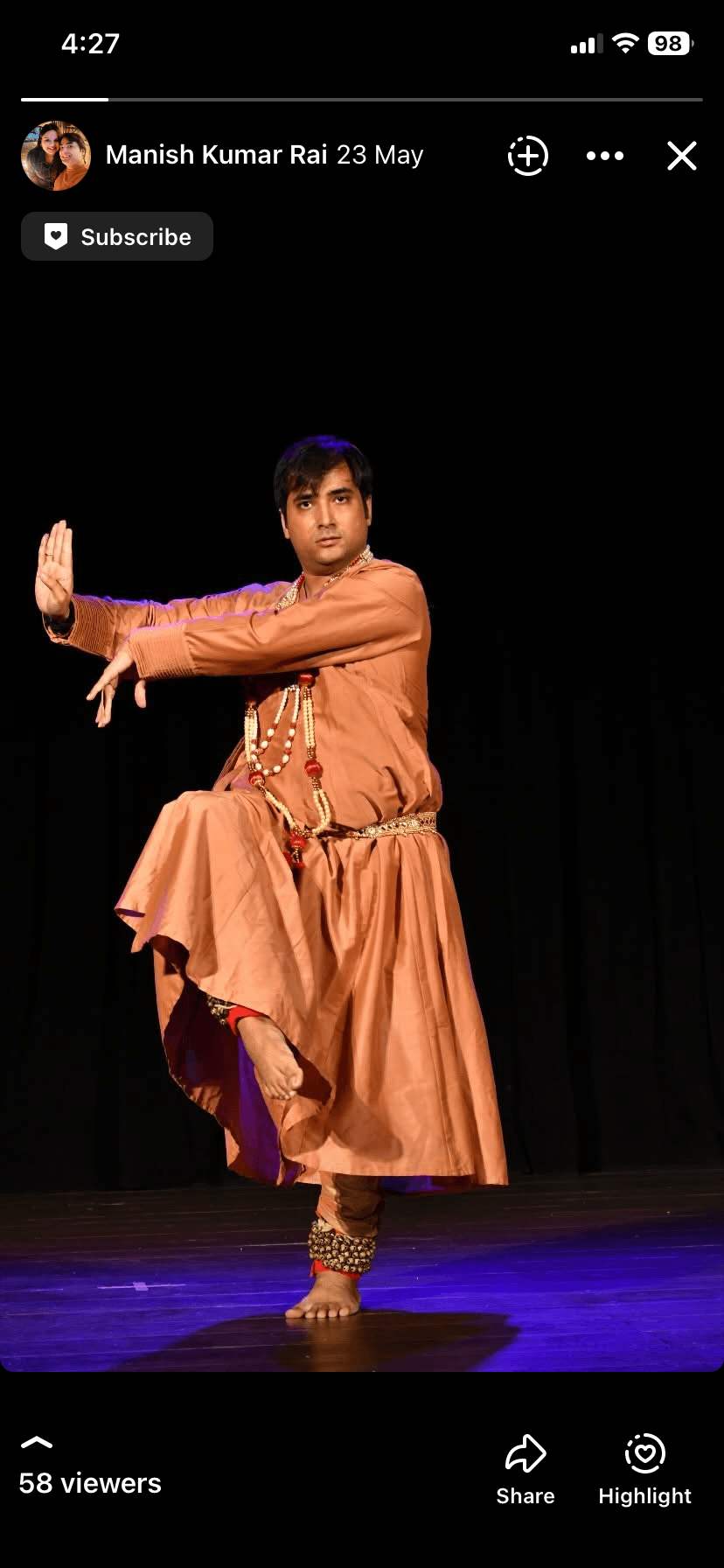
How did dance first find you — was there a moment you knew this was going to be your life?
I was seven years old in 1994. Like most Indian households then, ours gathered around the television for Chitrahaar, the weekly window into the world of film songs. One evening, "Chane Ke Khet Mein" came on, featuring Madhuri Dixit, and something in me shifted. It wasn't just the dancing that held me. It was her expressions: the way her eyes, her smile, and even the smallest tilt of her head could tell a whole story without a single word. I sat completely still, mesmerised, not fully understanding what I was watching, only knowing that I didn't want it to end. My eldest sister, seeing how spellbound I was, told me, "That's Madhuri Dixit. She's a trained Kathak dancer." That one sentence stayed with me. In my seven-year-old mind, the logic was beautifully simple: if Kathak was what gave her that magic, then if I learned Kathak, I too could dance like her and express like her. I don't think I could have put it into words then, but that evening a seed was planted. It wasn't a career decision or a grand realisation. It was pure wonder. Yet that wonder never left me. It grew into a lifelong love for dance, and eventually into years of training in Kathak, Bharatanatyam and Odissi. Looking back, that song on a small television screen was the moment dance found me, long before I knew I would spend my life following it.
Tell us about the guru or teacher who shaped the dancer you are today.
My journey has been shaped not by one guru, but by several teachers and luminaries, each of whom opened a new door for me. It began in school with my music teacher, Nayana Banerjee, who gave me my first lessons in Kathak. She was the one who took that childhood wonder I felt watching Madhuri Dixit and gave it shape, teaching me the basics of footwork, rhythm and discipline. Without her patience in those early years, the spark might have stayed just a dream. As I grew, I had the immense privilege of learning from the late Padma Vibhushan Pandit Birju Maharaj ji. Being in the presence of such a towering master was humbling. From him, I learned that Kathak is not just technique but storytelling, that every glance, every gesture and every beat carries emotion. His grace and his joy in the art left a mark on me that I carry to this day. Alongside Kathak, another love was quietly taking root. When I watched Hema Malini's Durga ballet, I was captivated by the power and devotion of Bharatanatyam. Soon after, I began learning the form in my locality under my guru, Ajay Chakrapani. He introduced me to the precision of its geometry, the strength of its stances, and the deep spiritual roots of the form, which also nourished my love for mythology. Years later, I saw Dr. Sonal Mansingh perform Odissi, and once again I found myself completely spellbound by its fluidity, its sculptural poses and its lyrical grace. That performance inspired me to begin my Odissi journey at Urvashi Kalashrishti Dance Academy in Pune. Each of these gurus gave me something different: Kathak taught me expression, Bharatanatyam gave me strength and structure, and Odissi gave me grace. The dancer I am today is a blend of all three, and of every teacher who believed in me along the way.
What drew you to blend classical forms together rather than stay inside one tradition?
My decision to blend these forms came from experience, years of learning Kathak, Bharatanatyam and Odissi side by side and slowly noticing how distinct each one is, yet how deeply they are connected underneath. The more I studied the Natyashastra of Bharata Muni and Nandikeshvara's Abhinaya Darpana, along with many other texts, the clearer it became to me that all three forms grow from the same root. They are different branches of one tree. All three classical forms draw on the same foundations laid down in these texts: the hastas (single-hand and combined-hand gestures), the navarasas or nine emotional states, and the four modes of abhinaya: angika (body), vachika (word and song), aharya (costume and adornment) and sattvika (inner emotion). Each form also moves between nritta (pure rhythmic dance), nritya (expressive dance) and natya (dramatic storytelling). Because this vocabulary is common, a pataka or alapadma hasta, or the expression of shringara or veera rasa, can travel naturally from one form to another without losing its meaning. Kathak gives me an upright torso, rapid tatkar footwork, dazzling chakkars (spins), playful rhythmic dialogue with the tabla, and the mathematical delight of tihais. Its abhinaya is subtle and conversational. Bharatanatyam gives me geometry and strength: the deep araimandi half-sitting stance, crisp adavus, clean linear extensions of the arms and legs, and powerful jathis set to Carnatic rhythm. Odissi gives me fluidity and sculpture: the square, grounded chauka stance and the tribhanga, where the head, torso and hips bend in three opposing directions, like the temple sculptures of Konark and Puri. Its torso moves independently of the hips, giving it a soft, flowing, lyrical quality. The fusion works best at the points where the forms naturally meet: stance transitions, rhythm and tala, movement dynamics, and abhinaya. For me, blending does not mean diluting. I hold each form's grammar with respect, and I fuse them only where their logic allows it, never forcing one form to behave like another. My aim is to let each tradition speak in its own voice while showing the audience how beautifully these voices harmonise. That, to me, is the essence of what the Natyashastra teaches: that dance is one ocean, and each classical form is a river flowing into it.
Your world carries the name "Nrityaangan" — what does that name mean to you, and what is the space or troupe behind it?
Nrityaangan Dancefloor is the name of my online dance academy, and the name carries a lot of meaning for me. It comes from two words: Nritya, meaning dance, and Aangan, meaning courtyard. In the Indian home, the aangan is the heart of the house. It is the open, sacred space where the family gathers, where festivals are celebrated, where rangoli is drawn and where children first learn to play. So Nrityaangan literally means "the courtyard of dance," or simply, a dancefloor. But to me it is much more than a floor. It is a home for dance. For any dancer, the dancefloor is Swargaloka, heaven itself. In our mythology, Swargaloka is the realm of Indra, where the celestial apsaras such as Urvashi, Rambha and Menaka danced in his divine court. Dance there was not mere entertainment; it was an offering, a form of worship. Every time a dancer steps onto the floor, they enter that same space, a place where the everyday world falls away and only rhythm, expression and devotion remain. At Nrityaangan, I teach Indian classical dance forms, Kathak, Bharatanatyam and Odissi, rooted in their traditional grammar of footwork, hastas and abhinaya. Alongside the classical, I also teach Bollywood dance, because film songs are where my own journey began and they remain a joyful, accessible doorway into dance for so many people. And closest to my heart is the work of blending the classical forms with one another: exploring how the grounded geometry of Bharatanatyam, the sculptural grace of Odissi and the rhythmic brilliance of Kathak can flow together into one expressive language. Whether a student wants the discipline of a pure classical form, the energy of Bollywood or the creative freedom of fusion, there is a place for them here. That is the spirit I wanted Nrityaangan to carry. Even though the academy is online, I believe the aangan is not defined by walls but by the feeling it creates. Wherever my students roll out a mat in their living rooms and begin to dance, that corner becomes their own aangan, their own little Swargaloka. Through Nrityaangan, I hope to bring the beauty of Indian dance to anyone, anywhere, who feels its call, just as I once did as a seven-year-old watching a song on television.
What's a performance you're especially proud of, and where was it?
It was in Chikaballapur at Kanada Bhavan and it was a Shuddha Kathak performance. Shuddha means pure, so a Shuddha Kathak performance is Kathak presented in its traditional, classical form, without fusion or film influence. It is the dance as it has been preserved through the gharanas, especially the Lucknow gharana of Pandit Birju Maharaj ji, from whom I had the privilege of learning. It is a conversation between the dancer, the tabla, the melody and the audience, built on rhythm, mathematics and storytelling. Most Shuddha Kathak performances are set to teentaal, a 16-beat cycle, and they unfold gradually across three tempos: vilambit (slow), madhya (medium) and drut (fast). The journey from slow to fast is what gives the performance its build-up and its thrill. For me, Shuddha Kathak is where discipline meets freedom. The structure of the tala is strict, but within it there is endless room for improvisation, emotion and play. Every performance is different, because the conversation with the musicians is alive in that moment. It is also the form where my journey began, so performing Shuddha Kathak always feels like returning home.
Which forms did you weave together in this fusion piece, and what sparked the idea?
This performance is very close to my heart because it brings together the three classical forms that have shaped me as a dancer. Rather than mixing them randomly, I asked myself a simple question: what is each form's greatest strength? Then I built the piece by letting each tradition contribute what it does best. From Kathak, I used tatkar, the intricate footwork where the ghungroos become a percussion instrument in themselves, along with tihais that land precisely on the sam. The chakkars, Kathak's signature spins, became the moments of climax, building speed and excitement before coming to a sudden, perfect stillness. From Bharatanatyam, I drew on its hastas, as codified in the Abhinaya Darpana. Bharatanatyam mudras are known for their clarity and precision. Every finger is placed with purpose, and the lines are crisp and geometric. This gave the storytelling a very clear visual language, so even audiences unfamiliar with classical dance could follow what each gesture meant. From Odissi, the piece got its soul. The performance was set to Odissi music, with its lyrical, devotional melodies and the gentle, rounded sound of the mardala. For the abhinaya, I used the soft, tender and deeply devotional expressions that Odissi is known for, rooted in the tradition of the Gita Govinda and the temple culture of Puri. Odissi expressions have a dreamy, inward quality that brought warmth and intimacy to the piece. The real work was in the transitions, because these forms have very different body languages. Kathak is upright and vertical, Bharatanatyam is grounded in the deep araimandi stance, and Odissi flows through the curves of the tribhanga. I had to find moments where one could melt into another naturally. For example, I would let a series of Kathak chakkars come to rest in a sculptural Odissi pose, so the speed resolved into stillness and grace. Another challenge was rhythm. Kathak footwork is usually performed to the tabla, so adapting tatkar to Odissi music and the mardala required me to rethink my rhythmic phrases so they sat comfortably within the Odissi musical structure while still keeping Kathak's sharpness. The mudras also needed care. Bharatanatyam hastas are crisp and angular, while Odissi movements are soft and fluid. I kept the precision of the Bharatanatyam gestures but allowed them to flow with the softness of the Odissi mood, so they felt like one expression rather than two separate styles. For me, this performance is proof that our classical forms are not separate islands. They share the same roots in the Natyashastra, the same vocabulary of rasa and abhinaya, and the same devotional spirit. When they come together with respect for each tradition's grammar, they create something new while still honouring where they come from. That is what I try to teach at Nrityaangan as well: to know each form deeply, and then to let them speak to each other.
Tell us about the people in this photo — who are they to you?
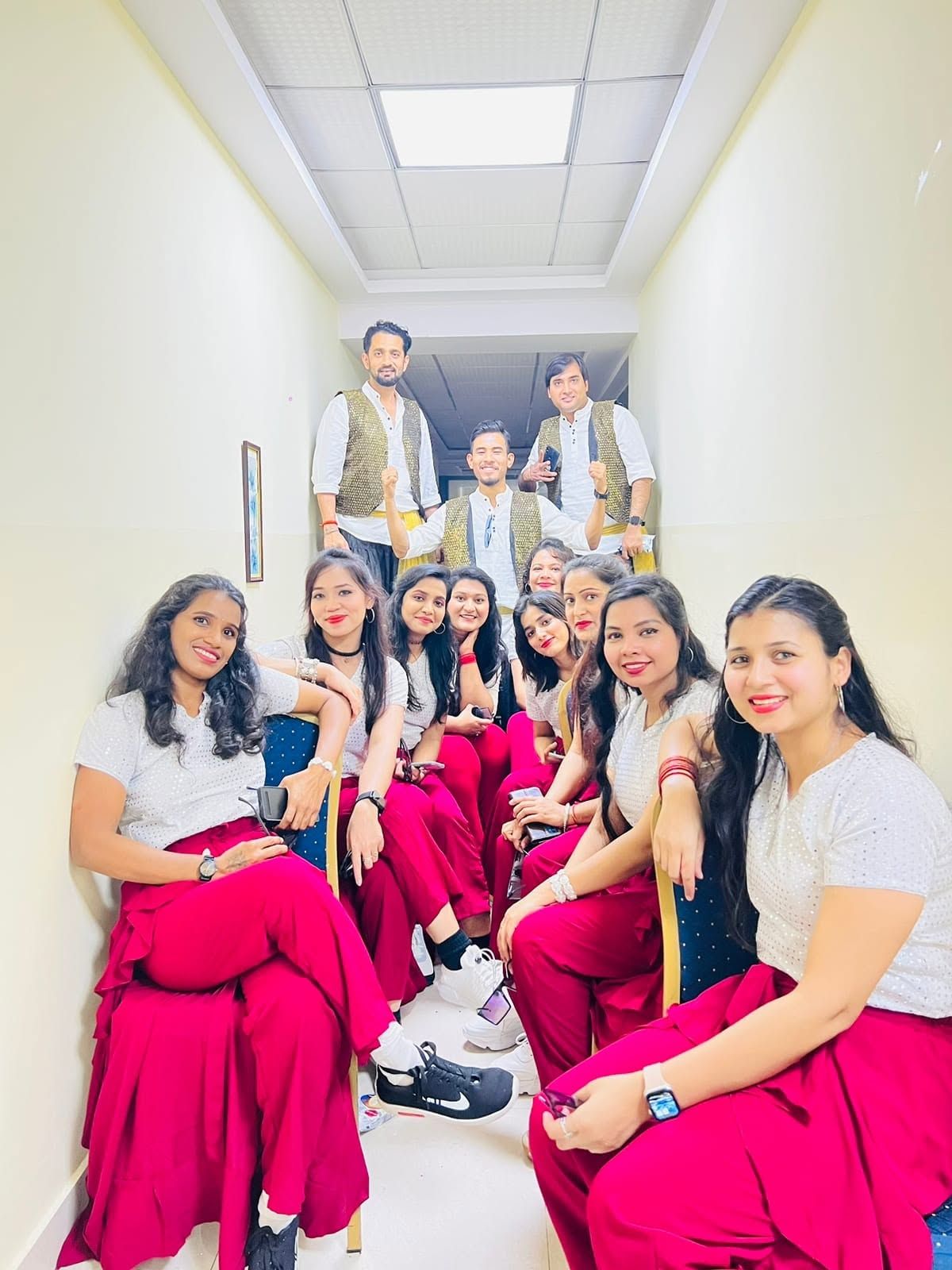
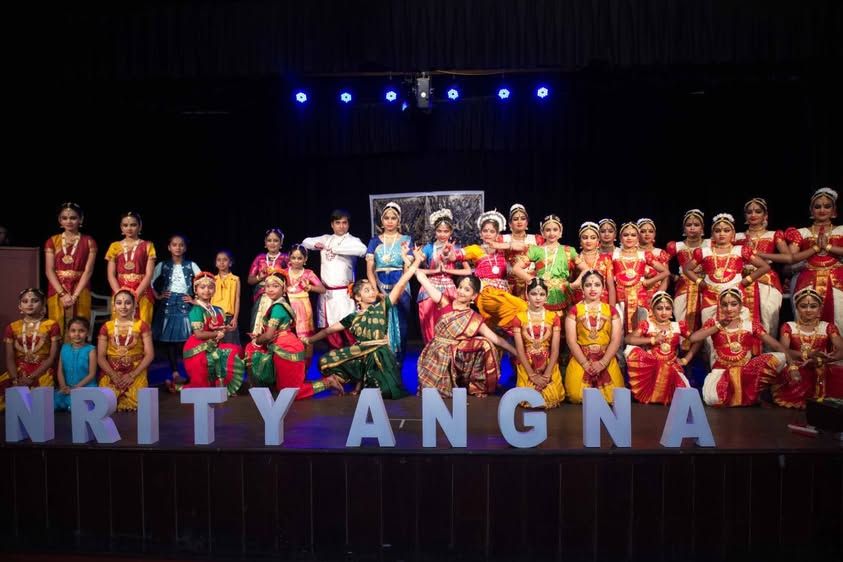
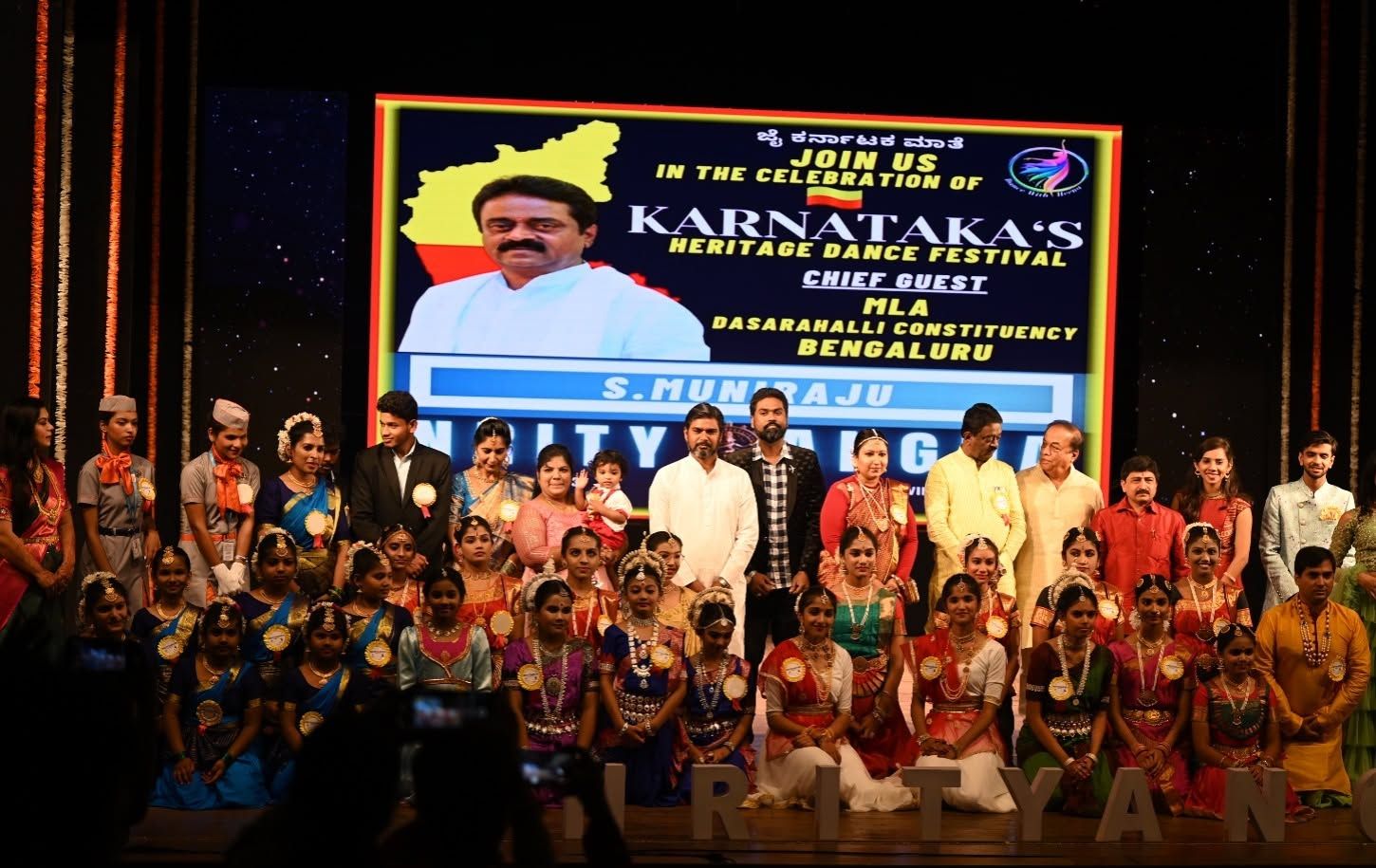
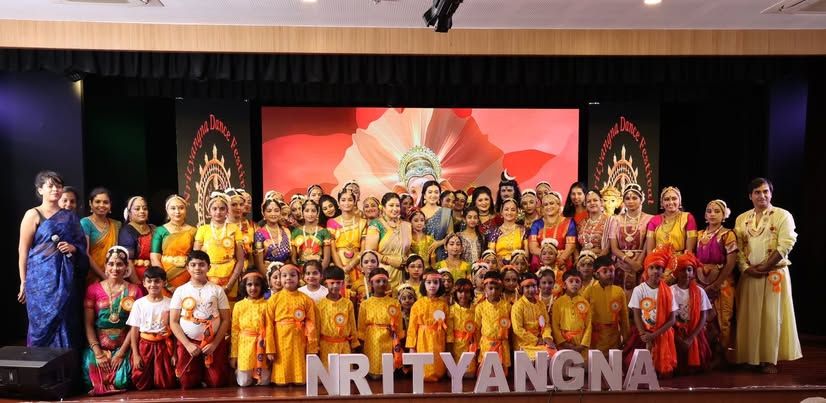
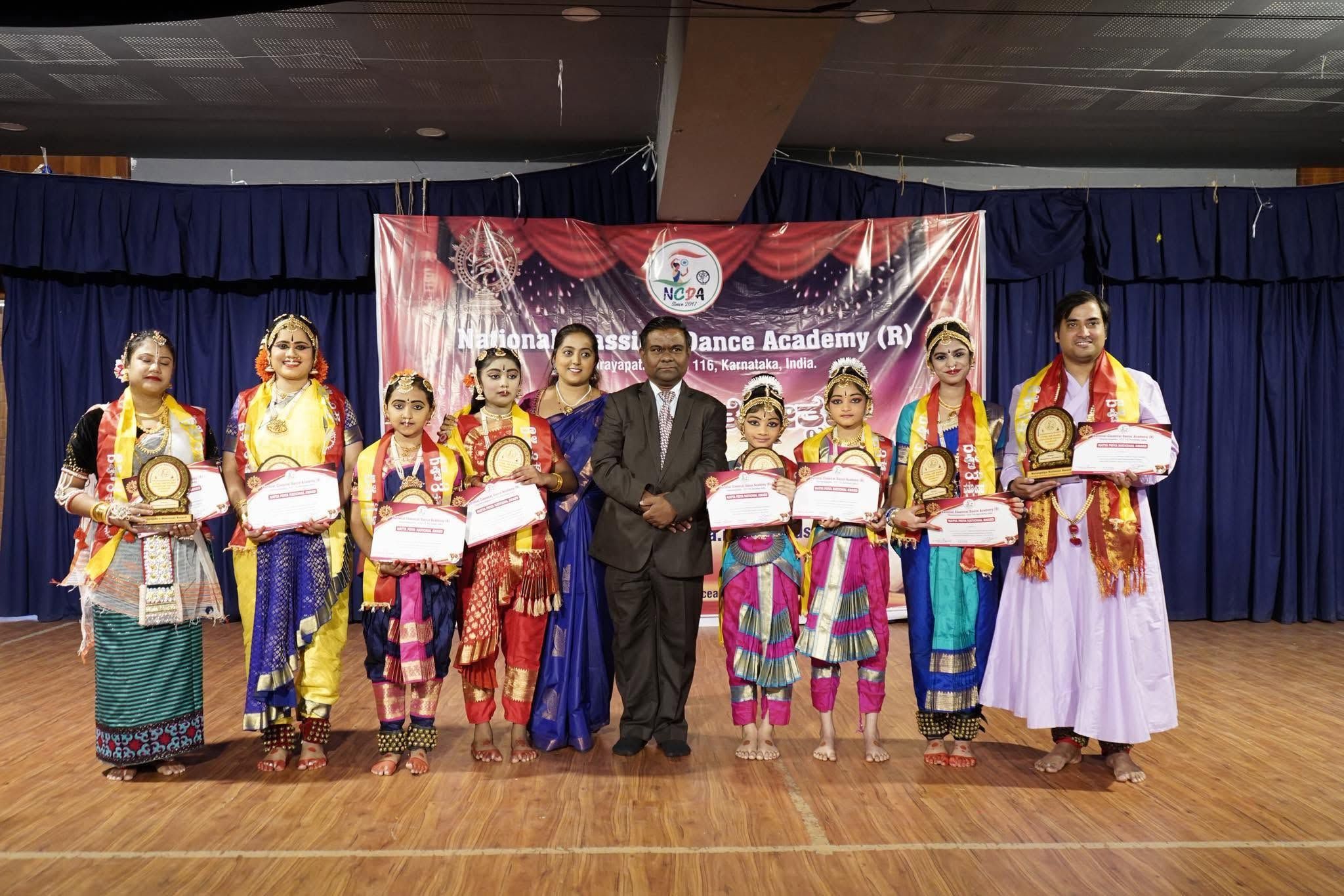
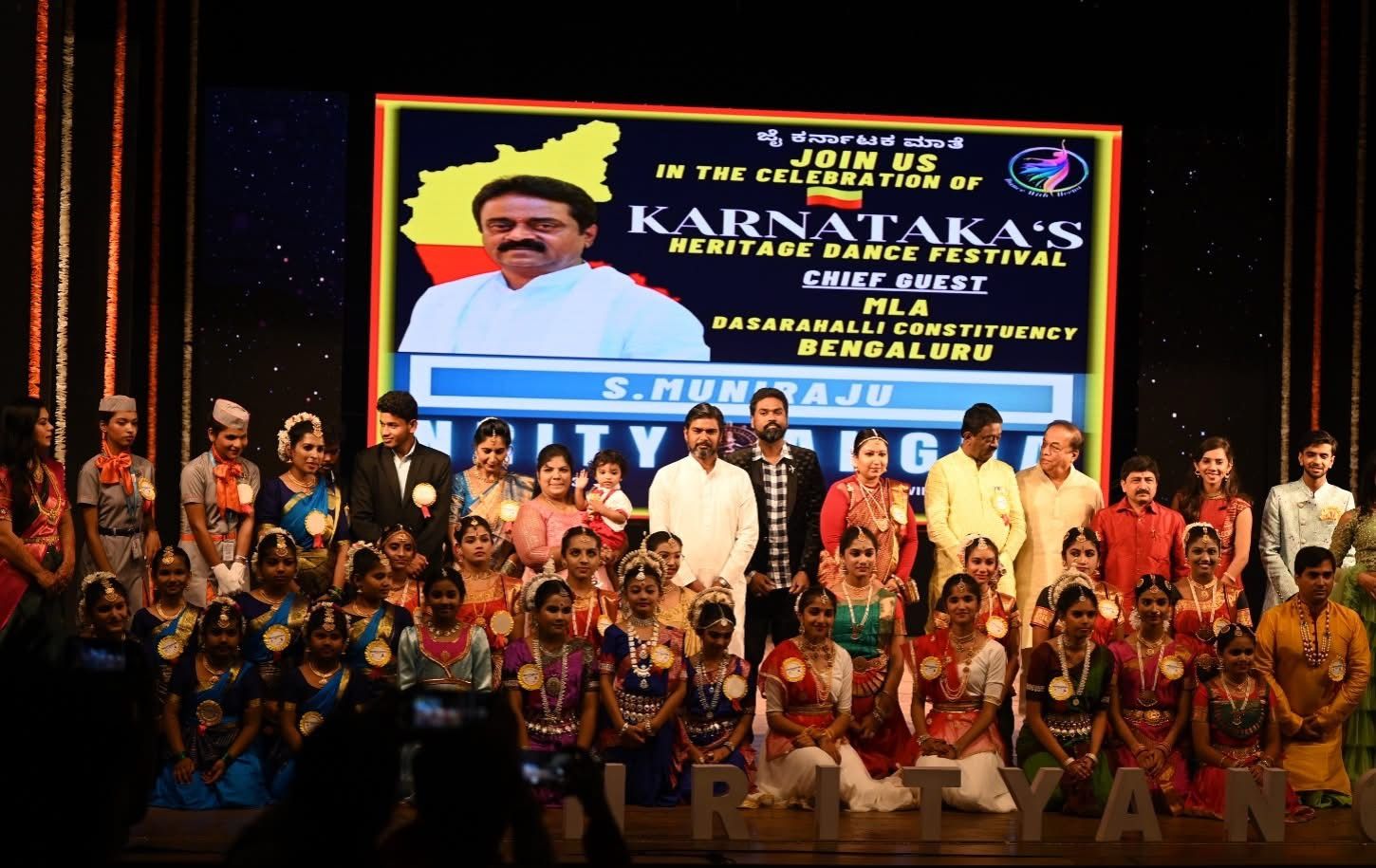
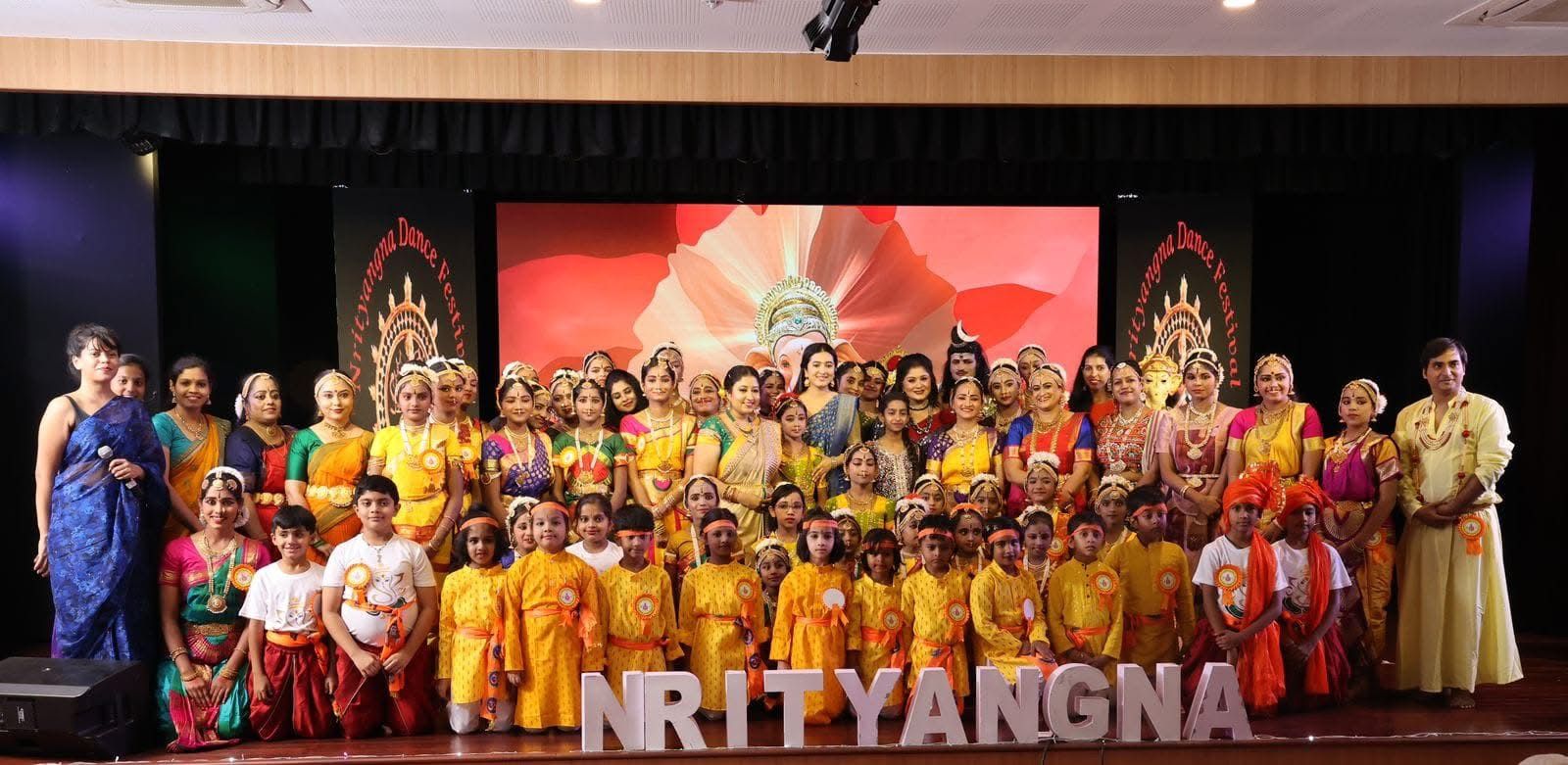
They are my students from different disciplines of dance styles, from Kathak to Bharatanatyam to Odissi.
What does that moment usually feel like, right before you step on stage?
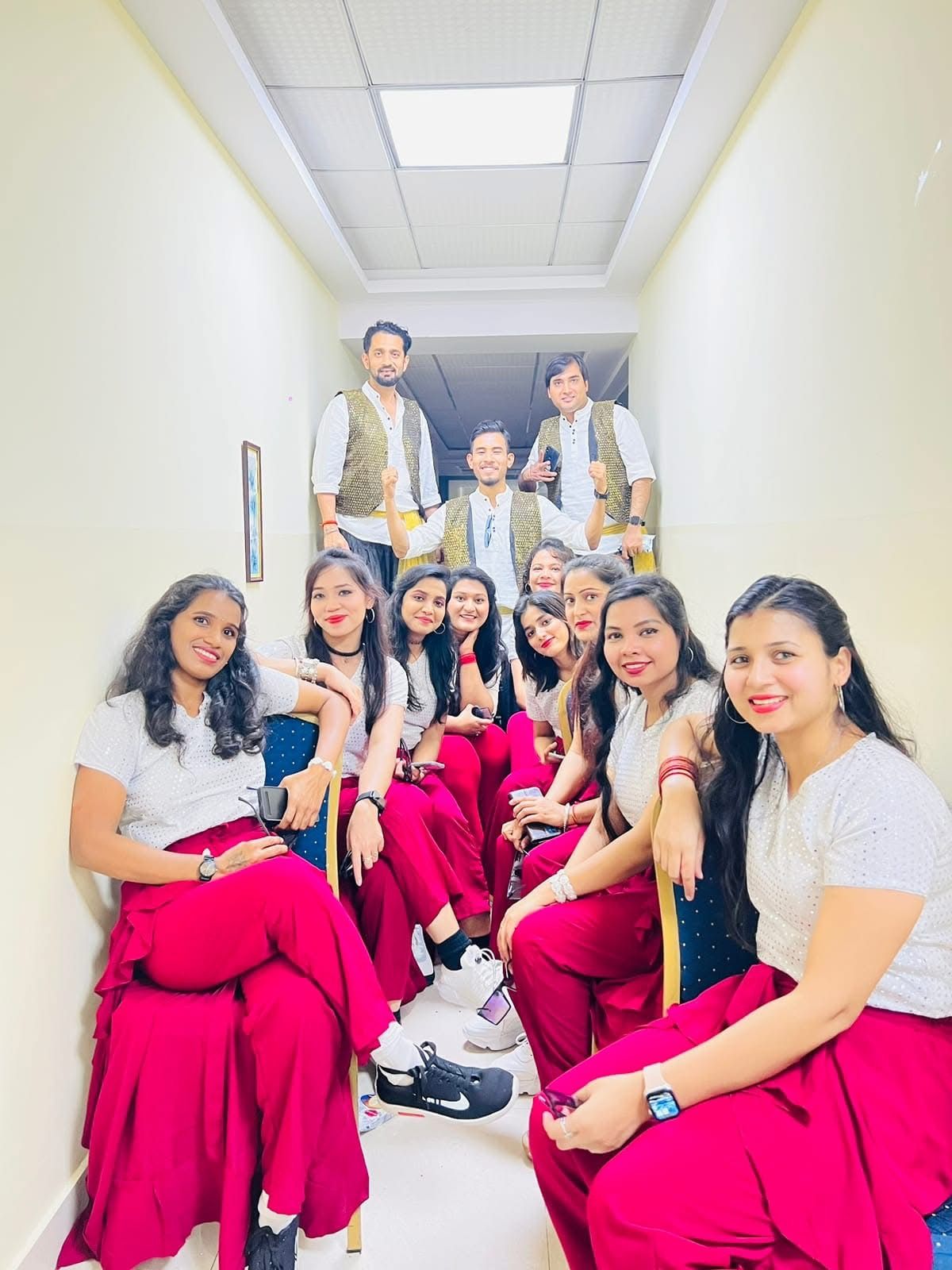
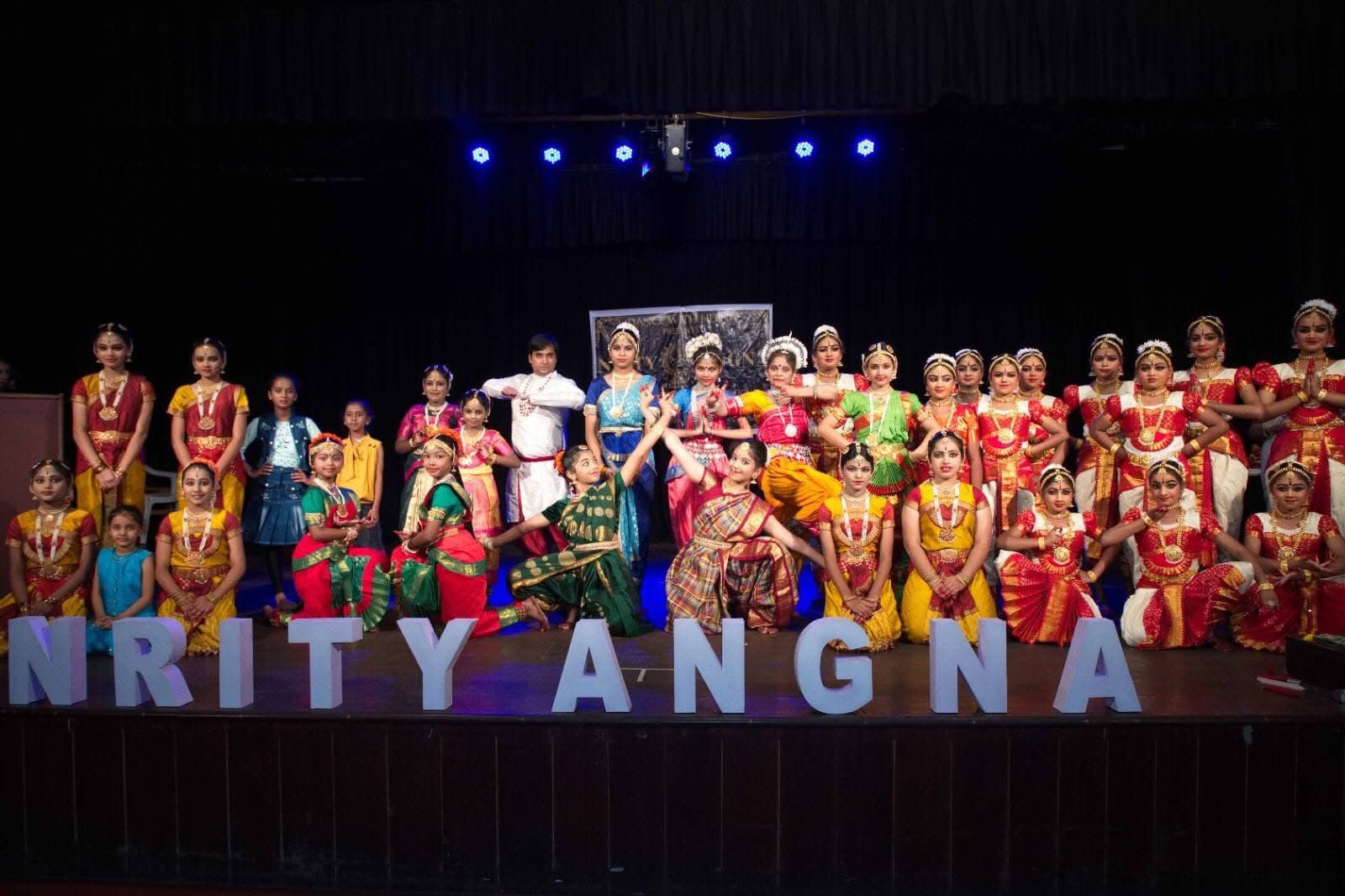
Even after more than 30 years of dancing, I still feel butterflies in my stomach before I step on stage. And honestly, I hope that feeling never goes away. In those last few moments in the wings, everything becomes very still and very loud at the same time. I can hear the murmur of the audience, the musicians tuning, and my own heartbeat, which suddenly feels like a tabla playing in my chest. My mind races through the choreography one last time, the tihais, the transitions, the moment a chakkar must land exactly on the sam. There is always that small voice asking, "Am I ready?" But over the years, I have learned that those butterflies are not fear. They are respect. They remind me that the stage is sacred, that the audience has given me their time and attention, and that the art I am carrying is far bigger than me. The day I stop feeling nervous would be the day I start taking the stage for granted. So in those moments, I close my eyes, take a deep breath, and offer a silent prayer to my gurus and to Lord Nataraja. As I touch the floor in bhumi pranam, asking forgiveness of Mother Earth for stamping on her, something shifts. The nervousness slowly turns into energy, and the butterflies start to dance with me. And then the music begins, the first step falls, and all the anxiety simply melts away. In that instant, I am no longer the person who was nervous in the wings. I am just a dancer on his dancefloor, his Swargaloka, exactly where he belongs.
What is it, and why does it excite you?
I'm creating a dance composition on the title song of the TV serial Jai Hanuman, composed by the late Ravindra Jain ji. The song is around 11 minutes and 42 seconds long and celebrates Lord Hanuman, his stories and his mahima. What makes it so special for a dancer is that, across its stanzas, it moves through all the navarasas, the nine emotional essences described in the Natyashastra and later classical tradition. That makes it almost a complete lesson in abhinaya within a single song. Hanuman's life is so rich that every rasa finds a home in it. The song gives me the chance to explore moments such as: Hasya (humour): the mischievous child Hanuman leaping to swallow the sun, mistaking it for a ripe fruit. Veera (heroism): his fearless leap across the ocean and his valour in battle. Raudra (fury): his rage as he sets Lanka ablaze. Bhayanaka (fear): the terror he strikes into the hearts of the rakshasas. Bibhatsa (disgust): the grotesque demons and obstacles he confronts on his path. Karuna (compassion): Mata Sita's sorrow in Ashok Vatika, and Hanuman's tenderness towards her. Shringara (love): the eternal love of Ram and Sita, which he serves and reunites. Adbhuta (wonder): the awe of him lifting an entire mountain, or revealing Ram and Sita within his heart. Shanta (peace): the deep stillness of his devotion, lost in the name of Ram. Rather than assigning one dance form to the whole piece, I've treated each stanza as its own world. For every stanza, I ask which rasa it carries and which elements from Kathak, Bharatanatyam and Odissi can best express it, and then blend them in different proportions. When the rasa is veera or raudra, the blend leans on Bharatanatyam's grounded strength and sharp lines, charged with Kathak's powerful footwork. For adbhuta and moments of speed and flight, Kathak's chakkars take the lead. When the mood turns to karuna, shringara or shanta, Odissi's soft tribhanga and lyrical abhinaya come forward, while Bharatanatyam's precise mudras keep the storytelling clear. So the three forms are always present, but each stanza has its own distinct colour depending on the rasa it expresses. Holding an audience for nearly 12 minutes requires careful pacing. Moving between rasas, from the playfulness of hasya to the fury of raudra to the stillness of shanta, keeps the emotional journey alive. The real craft lies in the transitions, making sure that the change of rasa and the change of blend feel like one continuous story rather than separate segments. As a dancer and as someone who is writing a book on our Sanatan history, this composition brings my two passions together. It is an offering to Hanuman ji. He teaches us that true strength comes from devotion and humility, and I hope that through all nine rasas, the audience feels not just the beauty of our classical dances but a little of his bhakti.
When a performance ends and the music fades, what do you hope people carry home with them?
I hope people carry the different concept they have witnessed rather than just a regular performance and forget about it. When the last beat falls and the music fades, there is always a moment of silence before the applause. For me, that silence is the most precious part of the performance, because it tells me the audience is still inside the story with me. What I hope people carry home is not the memory of a perfect chakkar or a complex tihai. Those are only the vehicles. I hope they carry home a feeling. Whether the performance spoke of devotion, love, valour, sorrow or joy, I hope that emotion stays with them, and that someone recognises a piece of their own life in it. That is the true purpose of rasa as the Natyashastra describes it: the emotion doesn't remain on stage; it is meant to be tasted and experienced by the rasika, the viewer. I also hope they carry home a sense of pride and curiosity about our heritage. Our classical dances hold thousands of years of stories, philosophy and devotion. If even one person goes home and reads about the story they just watched, explores our mythology, or decides to learn a classical dance form themselves, then the performance has done something far greater than entertain. And perhaps most of all, I hope someone in the audience feels the way I felt at seven years old, watching a dancer on a small television screen: that spark of wonder, that quiet thought of, "I want to do that too." Somebody once lit that lamp in me without even knowing it. If my dance can light a lamp in someone else, then the music never truly fades. It simply keeps dancing in them.
Contact and Follow
Email: manish.19011989@gmail.com