

How did percussion first find you — what's your earliest memory of being pulled toward rhythm?
It started as pure domestic mischief. Knuckles on the dining table, fingers tapping against car windows, upside-down sweet tins on the kitchen floor. I was obsessed with the fact that striking the middle of a tin gave you a dull bass thump, but clipping the rolled edge gave you a crisp snare crack. The real lightning strike, though, was standing next to a dhaak at a festival. That sound doesn’t register in your ears; it hits you right in the sternum. It was the first time I realized rhythm could be an overwhelming physical presence. From there, I needed a way to tame that power, which led me to the tabla. Classical tabla training gives you a complete rhythmic vocabulary—the microtonal slides of the bass skin, the mathematical precision of the strokes. Once your hands possess that kind of discipline, you start hearing possibilities everywhere. That curiosity gradually turned into passion and percussion became my way of expressing creativity and connection through music. The earthy swing of the dholak, the trance-like snap of the duff, the deep, centered rumble of the West African djembe, and eventually the acoustic economy of the cajon—they all fascinate me. They represent entirely different cultures, but the mechanics of the soul behind them are identical. Even on stage today, behind professional gear, I’m still chasing the exact same thrill I felt slapping the lid of a tin box as a child: the magic of taking a hollow, silent object and making it speak.
Was there an early moment when you realised this instrument was going to be a big part of your life?
I grew up in an intensely musical home, but with one major twist: practically everyone in my family was a vocalist. My siblings, my cousin sisters, my brothers—the house was constantly full of people practicing scales, harmonium bellows, and impromptu family jamming sessions where everyone could sing circles around me. Naturally, there was this unspoken expectation that I’d follow suit. But I was tone-deaf to the lyrics—I was obsessed with the floor beneath them. When they were singing, I wasn’t listening to the poetry; my foot was tapping out the tempo, or my fingers were rattling on the frame of the sofa, trying to find where the one landed. I became the designated rhythm section by pure necessity and instinct. Whenever the family gathered to sing, all eyes would eventually turn to me to set the groove, whether it was on a dholak, a tabletop, or just two hands clapping in sync. I realized very early that while a melody makes people listen, the groove makes people move. Surrounded by so many beautiful voices, someone had to hold down the ground—and I fell in love with being the anchor.
Who shaped you as a player — a guru, a teacher, or someone whose playing you kept coming back to?
A teacher gives you the grammar, but the world teaches you how to speak. My foundation came from strict, traditional instruction—the grueling hours of riyaz, learning hand placement, and training my fingers not to fight the skin. But beyond the classroom, I shaped my sound by being a relentless student of live performance. I made it my business to see eminent musicians across every tier—local, national, and international. Locally, I learned from the unsung players—the folk percussionists at community gatherings and festival drummers who possessed an earthy, instinctive pocket you simply cannot learn from a book. They had this relentless, driving pulse that commanded an entire crowd. Nationally, watching the titans of Indian percussion was a masterclass in precision and artistry. They elevated the drum from a time-keeping tool to a lead voice, showing me how dynamics, speed, and complex time cycles can tell an emotional story. Internationally, seeing global percussionists tore open my imagination. It showed me how a West African rhythm can sit inside a Latin groove, or how acoustic hand drumming translates into modern contemporary arrangements. I stole with my eyes and ears from all of them. I’d watch how an international player controlled their dynamics, how a national maestro held the room in suspense with a half-second pause, and how a local street player played with pure, uninhibited joy. My voice on the drums isn’t just one lineage; it’s an ongoing conversation with every great player I’ve ever had the privilege to watch.
What's the instrument you play most, and what makes it feel like yours?
To understand my relationship with my instruments, you have to understand the two halves of my life: by profession, I’m a banker; by passion and purpose, I’m a percussionist. People are always surprised by that contrast. They see a banker as someone bound to suits, spreadsheets, and cold figures. But music is mathematics, too—just set on fire. The discipline and relentless focus I need in the corporate world are the exact same tools that fuel my riyaz. The drums are where the quiet order of my day turns into pure kinetic energy. My dholak has been by my side for over two years now. It has survived moves, late-night jams, festival marathons, and endless hours of sweat. It feels like mine because an old drum eventually memorizes its player. The rim has softened under my knuckles, the tuning ropes know the exact tension I like before a note blooms, and the bass skin has a warmth that only comes from years of hands sinking into it. It’s the sound of home. My djembe, on the other hand, is my thunder. It’s been with me for about one year. What makes it mine is the relationship between its tension and my touch. A djembe is physical—you play it with your shoulders, your core, and the full weight of your hands. Over time, the skin has shaped itself to my strike velocity; it yields a round, cavernous bass and a gunshot-clean slap without me having to force the tone. After a grueling week navigating financial markets, sitting down with those two drums doesn't feel like practicing an instrument. It feels like shaking hands with an old friend who knows every secret you have.
What was happening in that moment, and where were you playing?
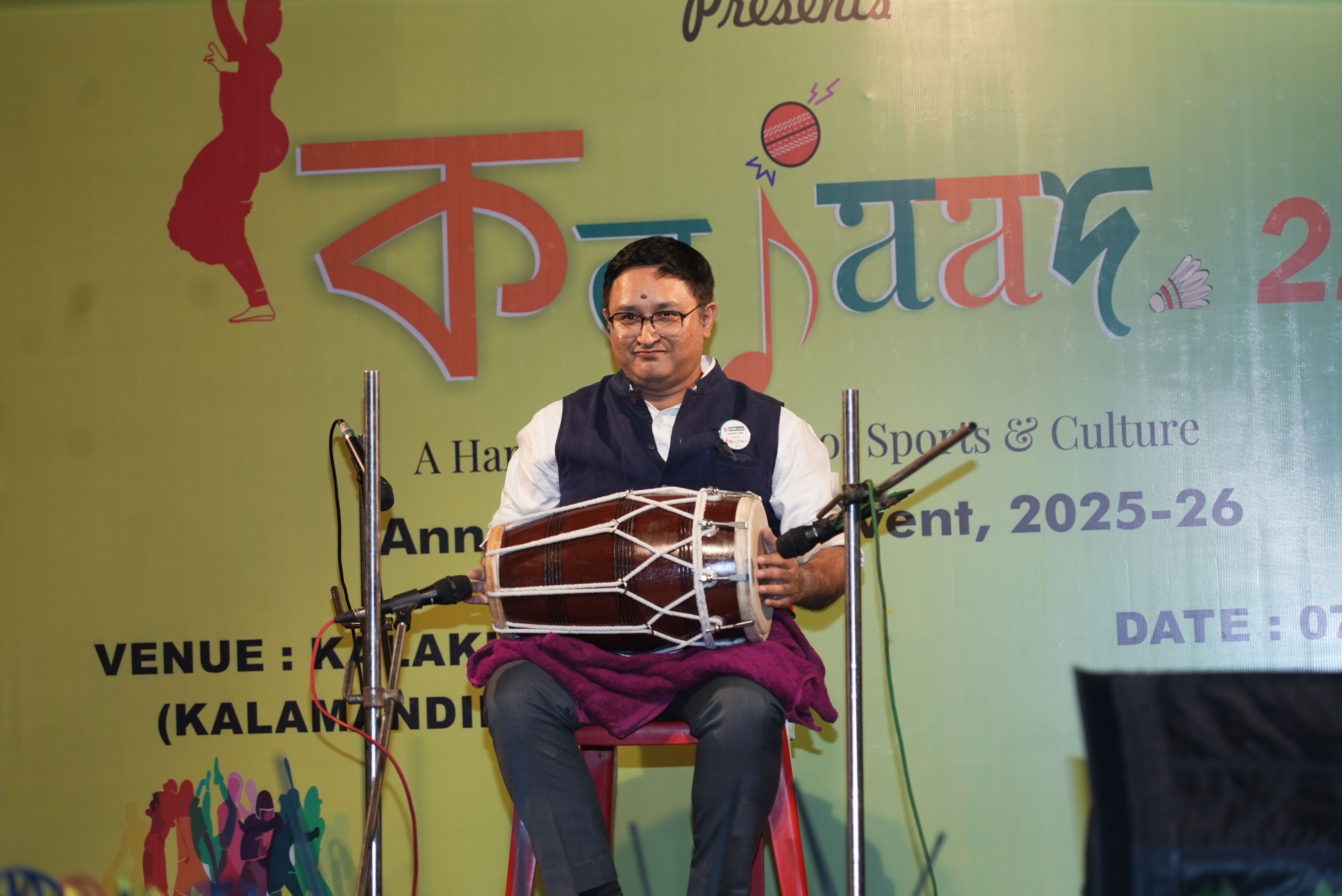
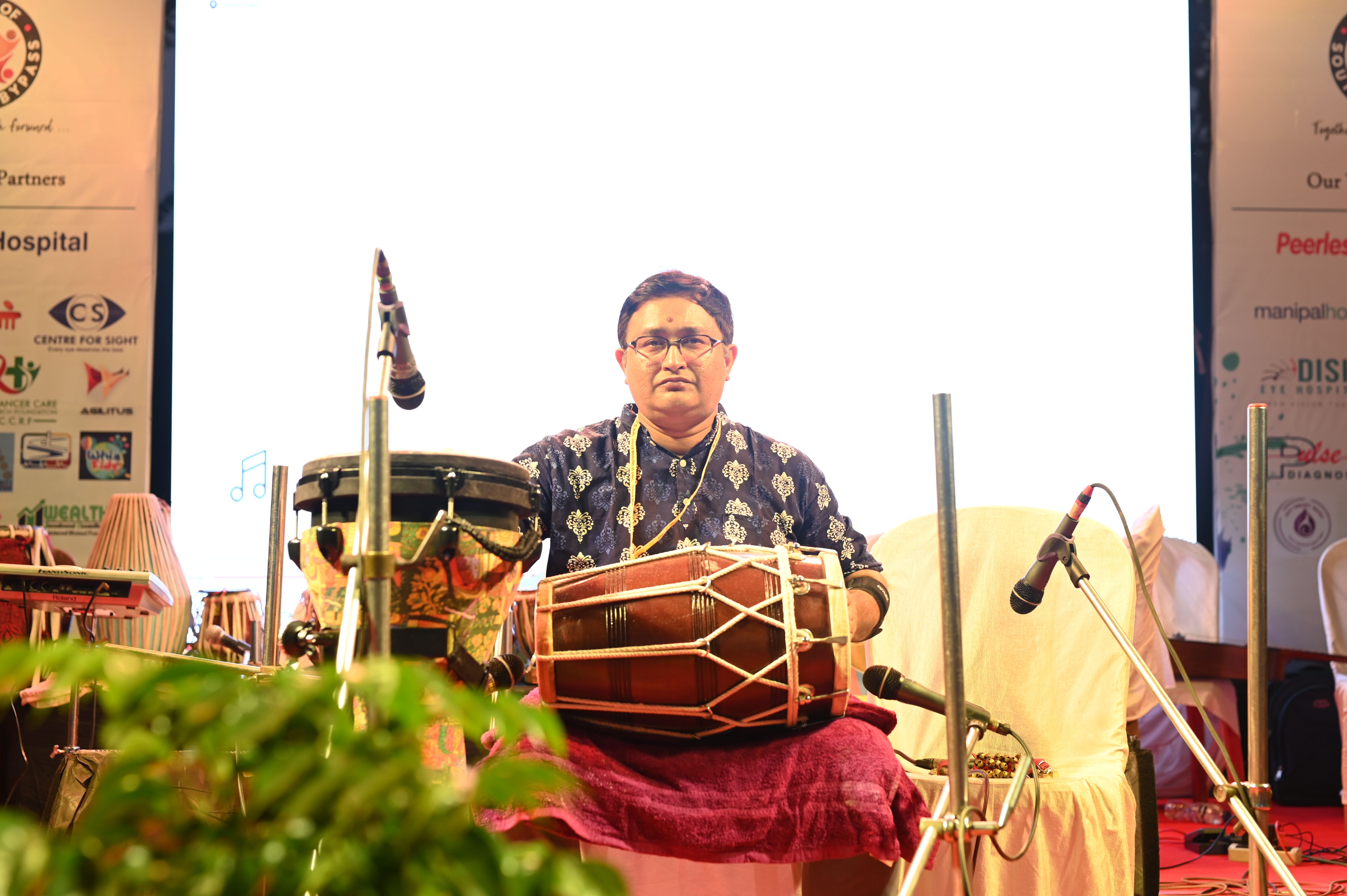
That was at Kalamandir in Kolkata, during an annual cultural concert. For anyone who grows up around Bengal's performing arts scene, playing on that stage is always a special milestone. I love this picture because it tells my whole story without a single word. I’m dressed in the clean, formal attire of my daytime world as a banker, but sitting behind the instrument that has had my heart since childhood. In that particular moment, the ensemble was deep into a composition "mere haathon me nau nai chudiyan" song from Movie Chandni composed by musical Maestro Shiv-Hari. I had the dholak balanced across my knees, cradled over a cloth to keep it steady, with both heads mic’d up for maximum acoustic punch. That slight smile on my face isn't posed—it’s that quiet moment of satisfaction when the tempo settles into the groove, and you realize the entire hall is breathing at the exact same tempo. It’s the ultimate decompression. You walk into that auditorium carrying the weight of meetings and balance sheets, but the second your palm strikes the skin and the sound rings through Kalamandir, you’re simply a percussionist in conversation with the rhythm.
What draws you to this one, and what should we listen for?
Timeless lyrics, an unforgettable melody, and Jatin–Lalit’s signature subtlety—anchored by a beautifully delicate use of the tabla that touches the heart every single time.
What's one thing about your technique that you've worked hardest on?
Unlearning twenty years of inertia, and then teaching a finger-style player how to hold a stick. I took a full twenty-year hiatus from serious playing while building my career in the banking sector. Stepping back into music two years ago was like an explosion of creative hunger—within those two years, I expanded my setup to include the cajon, the djembe, and the duff. But the biggest technical hurdle of my life was adapting to the duff with a stick. I am, through and through, a bare-hand player. My natural vocabulary is rooted in the subtle, tactile contact of finger pads and palms—the touch of a tabla or dholak where your skin feels every nuance of the head. When you pick up a stick to play the daf, that intimate connection vanishes. Initially, your wrist fights the balance, the dynamic range feels blunt, and you miss the dexterity of individual fingers. You have to completely recalibrate your sense of volume and time through an external tool. It demanded endless hours of basic wrist drills, working on rebound control and touch so that the stick didn't sound like a blunt hit, but had the crisp, singing attack that traditional daf playing demands. Overcoming that friction was one of the most rewarding milestones of my musical return. It reminded me that after two decades away, I didn't come back to coast on old habits—I came back to be a student again.
Walk us through what we're seeing — what's essential to how you play?
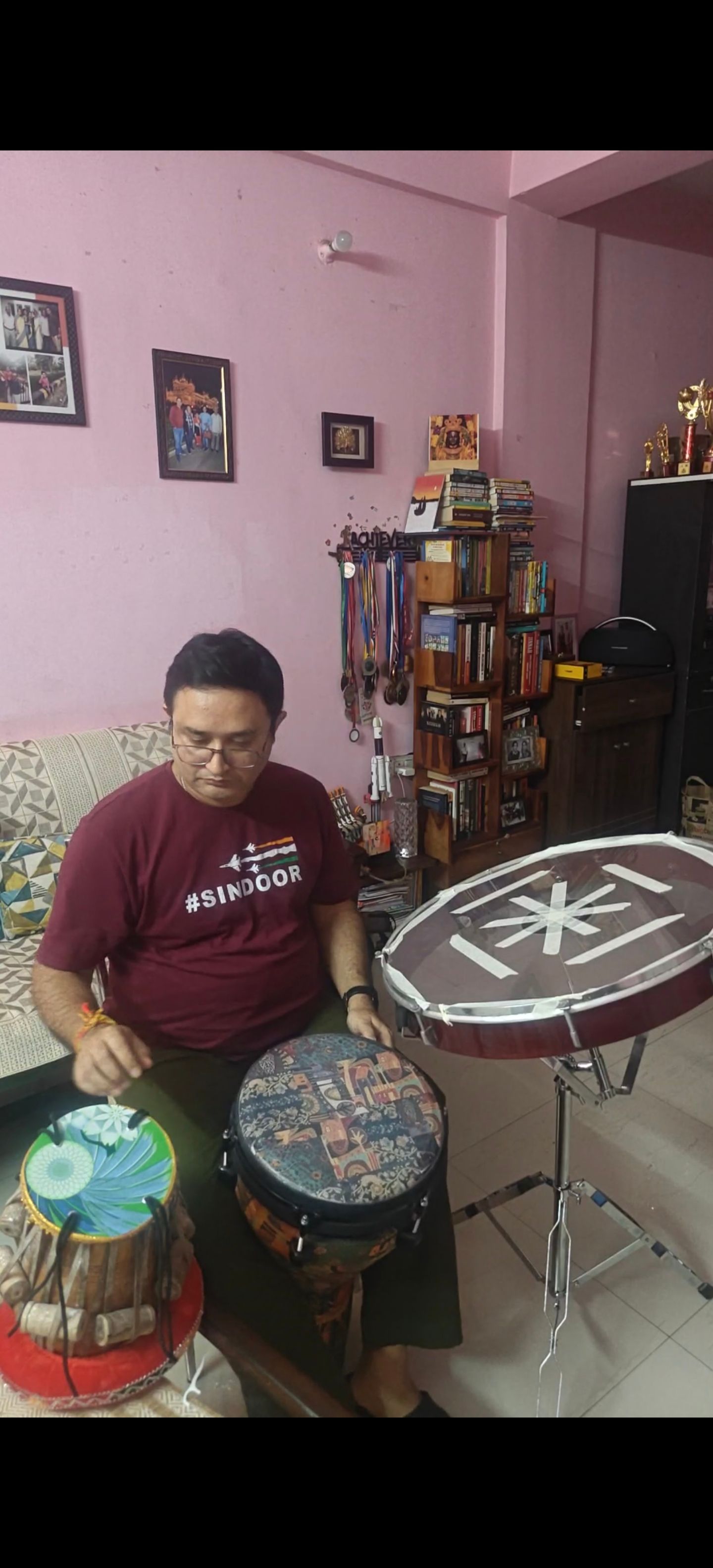
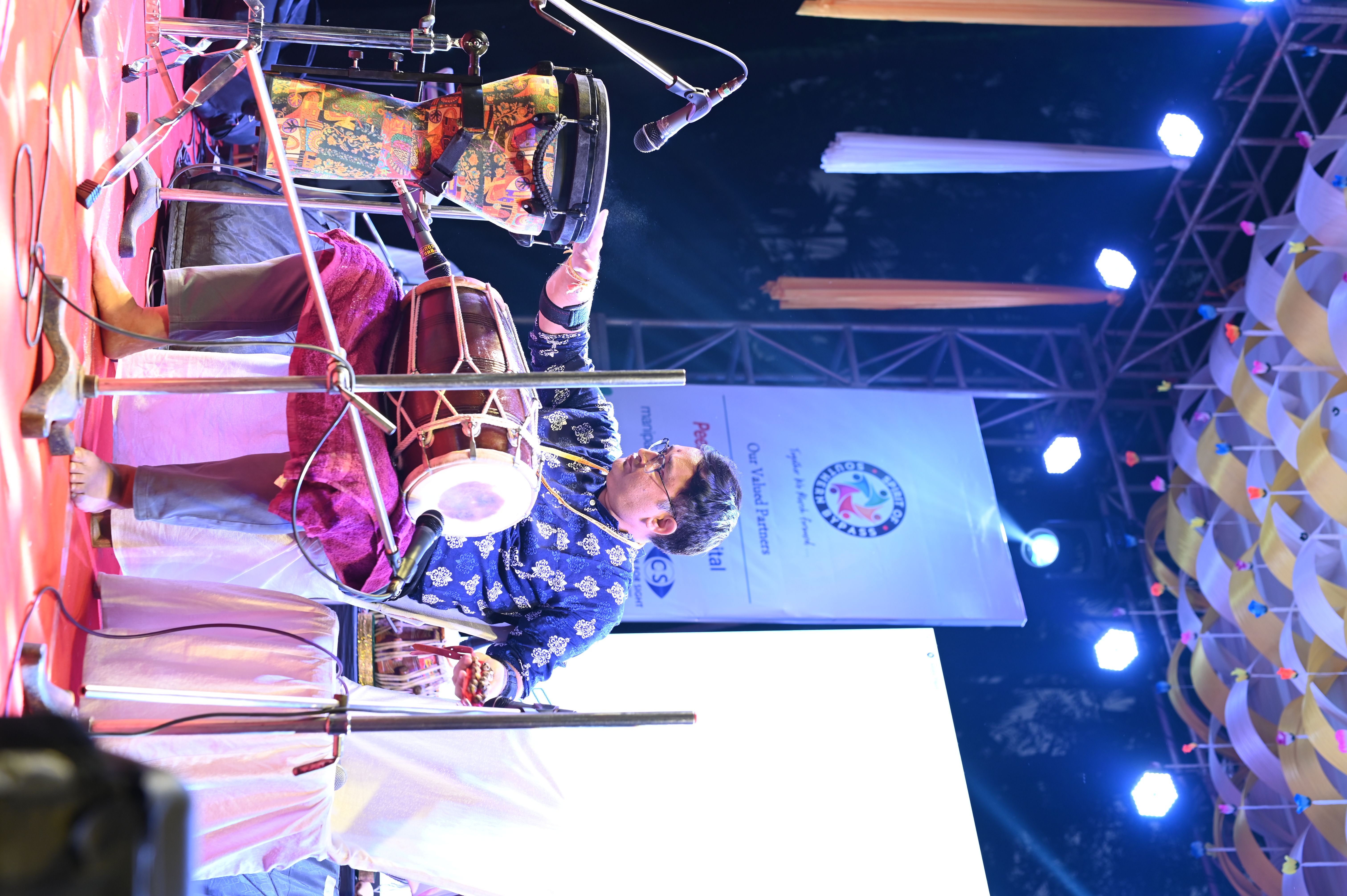
This was during a live rendition of A.R. Rahman Sir’s iconic 'Ae Ajnabi'—a track that is sacred to any percussionist who loves dynamic nuance. Rather than sticking to a single traditional drum, I designed a custom hybrid rig to play the daf, the tabla dayan, and the djembe all at once. The challenge with a Rahman composition is that you can never overplay; every stroke has to mean something. I used the djembe for the round, cavernous bottom end, the daf for its wide, sweeping rhythmic drive, and the tabla dayan for crisp, pitched articulation on top. Running that kind of multi-drum setup live demands immense mental coordination—your hands are essentially operating in three different percussion dialects at the exact same moment. It was demanding, but bringing those acoustic textures together for such a timeless song was an absolute thrill.
What is it, and where do you hope it takes you?
Right now, all my energy is dialed into rehearsals for the upcoming Durga Puja season. I’m putting together a high-energy live medley that journeys through three very distinct emotional spaces—starting with deep, grounded devotional classics, transitioning into the trance and drive of Sufi qawwalis, and culminating in full-throttle Bollywood dance grooves. Technically, it’s the most complex rig I’ve ever managed on stage: I’m alternating across five instruments—tabla, dholak, djembe, daf, and cajon. Every genre in the medley demands its own acoustic weight: you need the crisp grammar of the tabla for classical phrases, the raw festive punch of the dholak, the thunderous low end of the djembe, the airy snap of the daf, and the acoustic drum-kit feel of the cajon. It requires seamless mental shifting on the fly, but the energy of Durga Puja is electric, and I can’t wait to bring that hybrid sonic palette to the stage.
When a performance is really working, what does that feel like for you?
The biggest telltale sign for me is the audience. When a groove really locks in, the entire room begins to breathe on the same downbeat. You look out and see someone’s shoulder moving, or an older listener nodding in sync with the bass, and you realize you’re holding the emotional steering wheel of that entire hall. Coming back to music after twenty years away, those moments feel like an out-of-body experience. It’s a profound sense of relief and exhilaration—a reminder that no matter how chaotic the outside world gets, within those sixteen beats, everything is in absolute harmony.
Contact and Follow
Email: bjoydeep2@gmail.com
Instagram: https://instagram.com/jburbancruiser
Facebook: https://facebook.com/JB Bhatt