

Every singer has a 'first' — the first time your own voice surprised you. Where were you, what were you singing, and did anyone else hear it?
I think I was around seven or eight when I used to sing Jashn-e-Baahaara from the movie Jodha Akbar a lot. I’d sing the song, not even knowing what the words meant, and I’d go to my mom asking, “What does baahaara mean? What does jashn mean?” I didn’t realise it at the time, but that’s probably when my mom first thought I had something in music.
Mumbai is loud with music dreams. What made a kid from that city decide, 'I'm actually going to do this'?
Honestly, it started in a pretty cheesy way. I was a massive Shawn Mendes fan, and as a teenager, I wanted to be just like him. I’d listen to his songs and think, “I want to do this too.” Eventually, as I grew up, it slowly became less about wanting to be like someone and more about what music actually meant to me. It became an outlet for me. It gave me a sense of peace and calm, and something I genuinely enjoyed doing without ever getting tired of it.
Your bio says 'turning the emotions you feel into melodies.' Which emotion is the hardest for you to turn into music — and which one comes out almost on its own?
I think as an artist, I write about feelings I’ve actually experienced or lived through. So whether it’s love, heartbreak, happiness or loneliness, I find all of them equally difficult to write about. No matter how many words you put into it, you always feel like it’s not enough. You’re never completely satisfied because the song can describe the emotion, but it can never fully embody what you actually felt when you lived through it.
Was there a moment you almost gave up on music? What kept your hand from closing the laptop?
There have been quite a few times when I’ve thought, “Is this really going to work out?” I’d be posting content, writing songs, making music, networking, trying to figure things out, but there was always that worry at the back of my mind about whether I was actually going to reach the level that I wanted to. Sometimes that doubt would get so strong that I’d think maybe I should just stop. But then I’d realise I didn’t actually want to stop making music. I was just scared it wouldn’t work out. And ironically, that thought became motivation to keep going.
You don't just cover songs — you flip them. When did you realise a faithful cover wasn't enough for you, and you had to reinvent instead?
I think I realised there were already so many people doing covers, and I didn’t want to just become another person singing the same songs in the same way. There’s nothing wrong with that, but I wanted to give people something a little different. I liked the idea of keeping the familiarity of a popular song people already love, while changing the music enough that they’d hear it in a completely new way. That balance between nostalgia and a surprise element really drew me to doing genre flips.
Share your 'Haule Haule – Funk Version' — the one that won you the award.
Walk us inside that flip: how did a smooth romantic classic become funk + hip-hop in your head?
There wasn’t really a big thought process behind it. I was listening to Haule Haule on Spotify one day, and I suddenly thought it would actually sound really good as a funk song. The lyrics have such a lighthearted, playful feeling to them, and I felt like that energy could work really well with a funk groove. So I just started experimenting with it, and that’s how the whole idea came about.
Share one from your 'this mashup should be lowkey illegal' series — your pick for the most gloriously chaotic one.
How does a mashup like that start — two songs stuck in your head at 2 AM, or a deliberate 'these should NEVER go together… but what if'?
There’s honestly no particular process. It’s usually very random. I could be cooking, working, or lying in bed at midnight and suddenly think, “Wait, these two songs might actually work together.” Then I’ll start experimenting with the tempos and see if they fit. I also think about whether their moods make sense together. You can’t just put any two songs together. The emotions have to make sense too, otherwise you end up ruining both songs.
You've literally rewritten songs — flipping the Metro track from sad to happy, rewriting another from 'someone who chooses to stay.' What gives you the nerve to rewrite a songwriter's emotion, and where do you draw the line?
For me, it’s more about challenging myself creatively than changing what the original songwriter meant. I find it really interesting to take a song and look at it from a completely different perspective. If I only change a few words while keeping the same story, there isn’t much room for me to explore creatively. But if I change the emotion or the perspective completely, it pushes me to think differently, while still keeping that familiarity and nostalgia of the original song.
What's an experiment you've tried that completely flopped — and what did that flop teach you?
I honestly don’t remember one specific experiment that completely flopped. There have definitely been ideas and songs I’ve worked on that never made it to Instagram because they just didn’t turn out the way I had imagined. Sometimes it’s the song, sometimes the production, or sometimes I just realise my voice doesn’t really suit it. I think that’s also part of experimenting. Not everything you make has to see the light of day.
You've posted raw takes — just your voice and a monsoon drizzle, no mic, no instruments. Which version of you feels more true: the studio producer, or the guy singing to the rain?
I think both sides feel true to me, just in different ways. Singing something raw takes a lot more attention because there’s nowhere to hide. The pitch, lyrics, emotion, dynamics, everything has to come together in that moment. In a studio, you can redo things and shape the song. But when it’s just me singing and the listener, there’s a different kind of connection. It’s less about perfection and more about relatability.
You've done one-take covers like Jugraafiya and said it's way harder than it looks. What does it feel like in your body during a take you know you can't mess up?
It’s honestly harder than it looks. Before a one take cover, I usually practice it quite a bit because there are so many small things to keep in mind, like the lyrics, breathing spaces, pitch, dynamics etc. Once I start recording, I just try to stay focused and get through the whole thing without letting one small mistake throw me off.
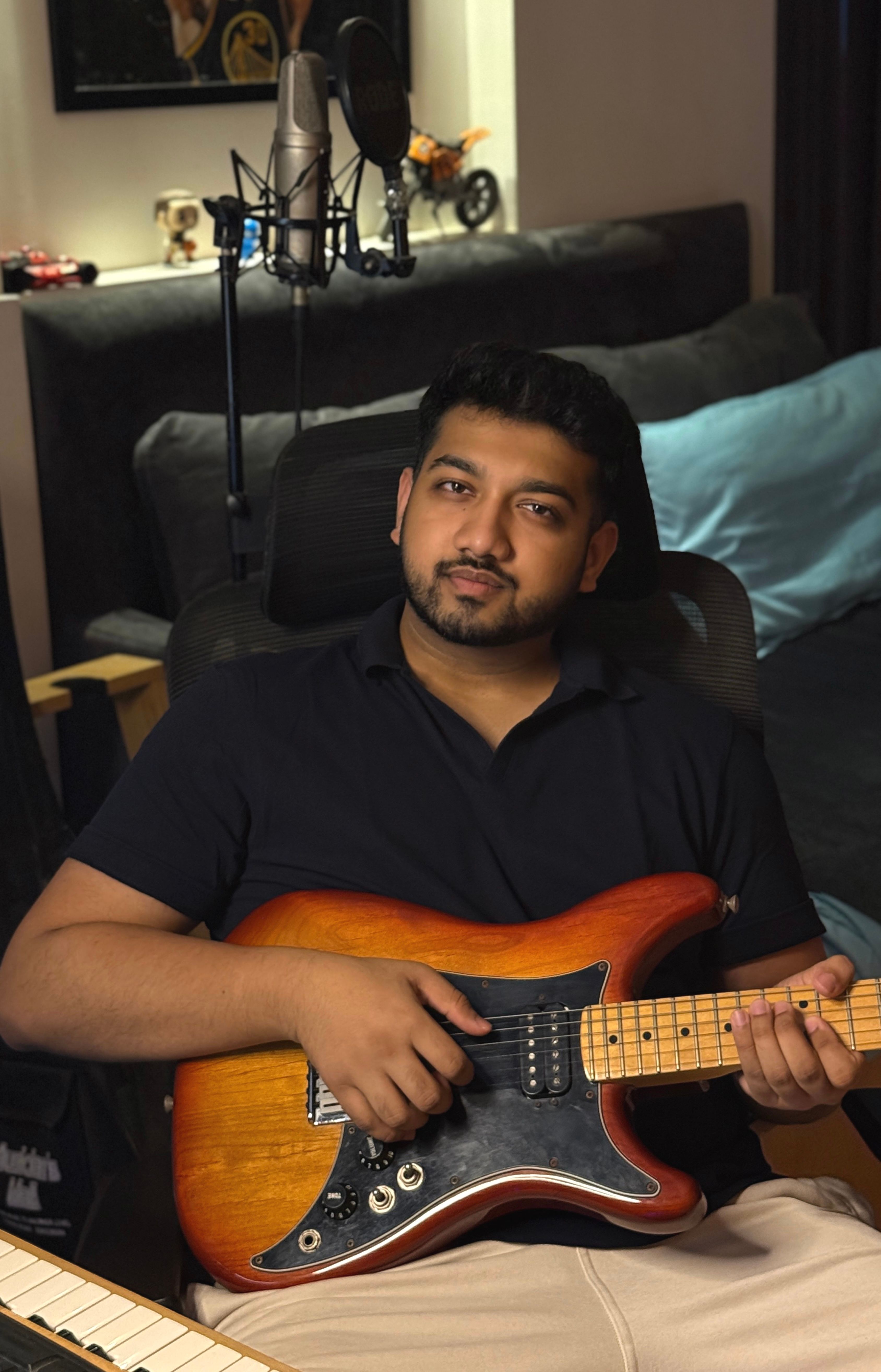
Guitar or piano — which one do you reach for when you're writing for yourself, not for the algorithm? Why that one?
I think it really depends on the song. I naturally reach for the guitar more because that’s what I started learning first, and it’s still one of my favourite instruments. But there are certain songs where the piano just makes more sense and helps me think differently. So I don’t really have a fixed process. I usually just pick up whatever instrument I have around and start playing.
You don't just sing — you mix and master, even for other artists. What's a production detail you obsess over that a normal listener will never consciously hear, but would feel if it were missing?
I think it starts even before you actually start producing. Having a clear idea of what the song needs, what it should feel like, and choosing the right sounds and arrangement can make a huge difference. I’ve realised that a song doesn’t need 100 tracks to sound big. Sometimes a really simple production can have much more impact if every sound has a purpose and you know what the song actually needs.
Share something you produced for someone else that you're proud of.
What's different about serving someone else's voice versus your own?
With my own music, I already know my voice, my strengths, my weaknesses, and what I like, so the process is usually much faster. But when I’m working with someone else, I have to understand them first. Their voice, range, strengths, weaknesses, their taste, and most importantly, what they actually want the song to sound like. It’s not about making it sound like me. It’s about figuring out how I can bring that out in the best way possible.
Contact and Follow
Email: positiveshubh@gmail.com
Social Media: https://linktr.ee/shubhshahmusic