


How did your journey in photography begin?
I grew up moving across India because my father is in the Armed Forces, and somewhere in that constant displacement, I stopped arriving at places and started reading them. Not the landmarks — the margins. A cockroach cutting across a crowded footpath to the nearest wall. Kids turning a main road into a cricket pitch the moment traffic thins. Urban life and the living things inside it, negotiating space with each other.
That habit of watching came before any camera. My parents would drag me outside — the classic "go look at the greenery" — and I'd sit on a porch and just observe. Festivals, seasons, strangers mid-motion. At some point the watching needed somewhere to go, and that's when I got my hands on the classic old Sony DigiCam. I shot everything — the household pets became my first unwilling models. The photos were random, but the instinct wasn't.
By college, I had a Nikon D3100 and a Visual Communication Design course at Unitedworld Institute of Design in Gandhinagar that started turning the instinct into something I could actually control. A first-year module, good faculty — that's where the hobby started demanding more from me.
Now in my fourth year, the pattern is still the same. I arrive somewhere, the camera stays in the bag for an hour, and then it doesn't come out for three or four more. The seeing still happens first.
What was your first camera and how did it shape your work?
I started on a Sony DigiCam — no control, no understanding, just pointing at things. Then came four years with the Nikon D3100, and borrowing a friend's camera during shoots was what quietly educated me. Comparing frames from two different bodies taught me that gear creates a ceiling, even when you don't realise it yet. The D3500 raised that ceiling slightly. But the Nikon Coolpix P1100 — with its 24–3000mm zoom — broke something open entirely.
That lens taught me patience as a discipline, not a personality trait. To get the bird's eye, you don't move faster. You become invisible long enough for the world to stop performing. That same principle carried into street photography — a long reach means you're not interrupting a moment, you're catching one already in motion. The expression, the hands, what someone's body says about the work they do. But reach without restraint is just intrusion. When someone doesn't want to be seen, you lower the camera. That's non-negotiable.
Shooting alone sharpened everything faster. No one questioning your frame means no one eroding your instinct before you've even acted on it.
The last thing the gear taught me is that editing is where a photograph becomes mine. The camera gets me to the image. The edit is what earns it a place on my wall.
How has your experience grown across wildlife, street, and concert photography?
Growth in photography, for me, isn't measured in the number of shoots — it's measured in how much earlier I put the camera down.
I use a framework called OODA — Observe, Orient, Decide, Act. Most photographers arrive somewhere and immediately start shooting. I've trained myself to observe first, long enough that my subconscious has already catalogued the light, the movement, the tension in a space before I raise the camera. That instinct took years to build, and it shows differently across each discipline.
In wildlife, OODA is patience made structural. You don't find the shot — you wait for the world to hand it to you. The growth there was learning to be comfortable being invisible for long stretches and trusting that the moment will come.
Street photography added a different layer: consent and ethics. Skill gets you the frame, but knowing when not to take it — when someone's discomfort outweighs the photograph — that's a judgement call that only experience sharpens. I can't teach that. You accumulate it.
Concerts taught me spatial awareness I didn't know I lacked. You're managing two subjects simultaneously — the artist and the audience — and you cannot disturb either to get the shot. Early on I got the artist or the crowd. Now I'm getting both in the same frame, and the emotion reads in both directions.
Some shoots are bad. Some days I carry my camera and never fire it once — just observe. That's not failure. That's where a large part of the real learning happens.
Who or what inspires your photography style?
I have a collection of photographs of Mumbai from a hundred years ago. Same streets, same bones of buildings — but everything living inside them has shifted completely. Except some corners haven't. There are pockets of the city that look back at you like they're daring you to forget them. That tension between what stays and what changes is probably the truest answer to what drives how I shoot.
Growing up watching Animal Planet and NatGeo planted something early — the idea that a single frame could hold an entire world if the person behind the camera was patient enough to wait for it. Then came Instagram, where I'd see photographers travelling, shooting, editing work that looked like it belonged on walls — and I made myself a quiet promise that I'd get there. College at Unitedworld made that promise start to feel real. Field trips to Ahmedabad, Gandhinagar, Kutch — and back in Mumbai, I started keeping a running list of places I wanted to return to with a camera.
The honest answer is that my inspiration isn't a photographer or a movement. It's the feeling of standing somewhere that has survived longer than it was supposed to, and trying to make a frame worthy of that.
What wildlife photograph best represents your work, and what's the story behind it?
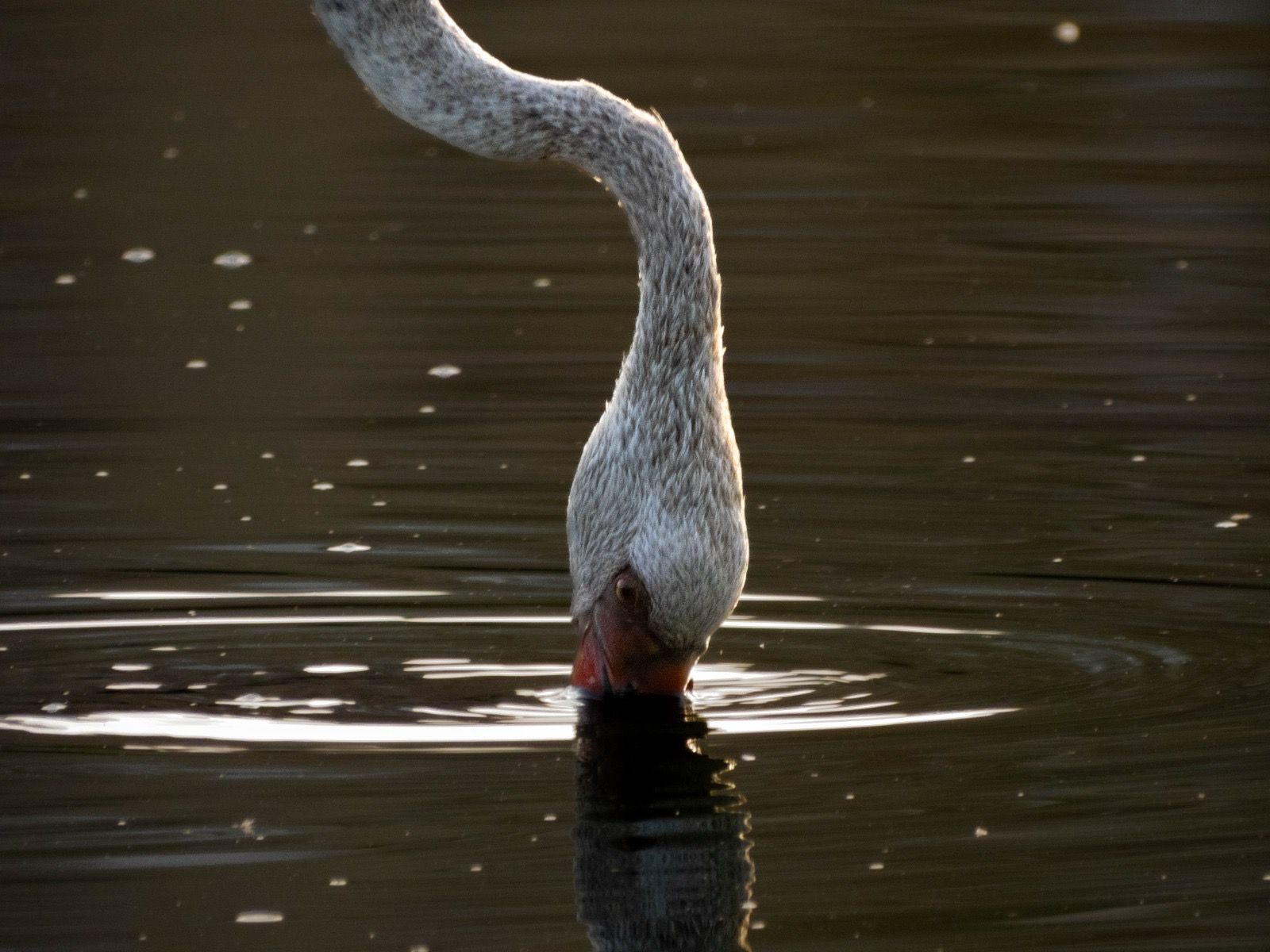
This was shot at Navi Mumbai — my first time ever seeing flamingos in person. I'd only ever seen them on NatGeo or through other photographers' work, so standing there watching them move through the water in real light was something that hit differently than I expected.
Most of my shots from that morning were of them standing in groups or shaking out their feathers. But this one caught something quieter — the bird mid-feed, beak submerged, that long neck arching down and curving almost out of the top of the frame. The ripples spreading out from where the beak meets the water became the composition I hadn't planned for. The backlight from the rising sun caught the texture of the feathers in a way that made the bird feel both delicate and completely focused on what it was doing.
There's something about flamingos that I found out only when I got there — they only settle where food is genuinely abundant. So that image of total absorption, the world reduced to just the water directly in front of them, felt like it was saying something true about what it looks like to be exactly where you're supposed to be.
What street photo captures a unique moment for you, and what's the story behind it?
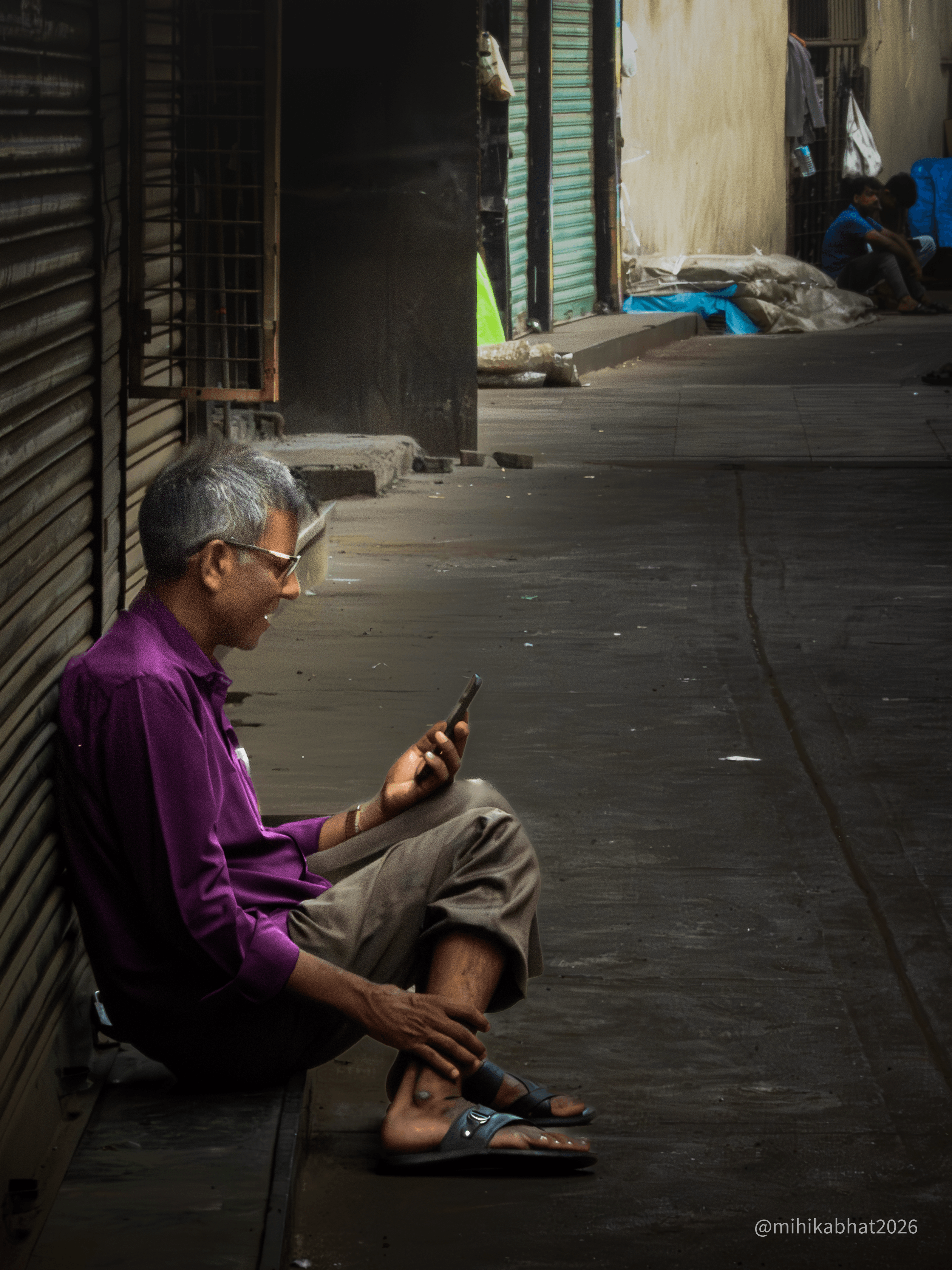
This was shot at Crawford Market, early on a Saturday morning around 7:30. Most of the market was still shut, which meant the streets had a stillness that doesn't exist once the day picks up.
I don't take my camera out immediately when I arrive somewhere — I scope the area first, read the space, identify my frames. At this crossing I had roughly ten seconds to make a decision. What caught my eye was the man seated on the sidewalk, on his phone — there was something in his posture and expression that suggested a private moment happening in a very public space. That contrast is what I was after. The stillness of the early morning around him made the intimacy of that moment more visible.
Whether he was calling home, wishing someone on a birthday, or just catching up — I don't know. What the frame holds is a person fully absorbed in a connection that exists somewhere else, while the city around him hasn't woken up yet.
What story does your concert photo tell about live music energy?
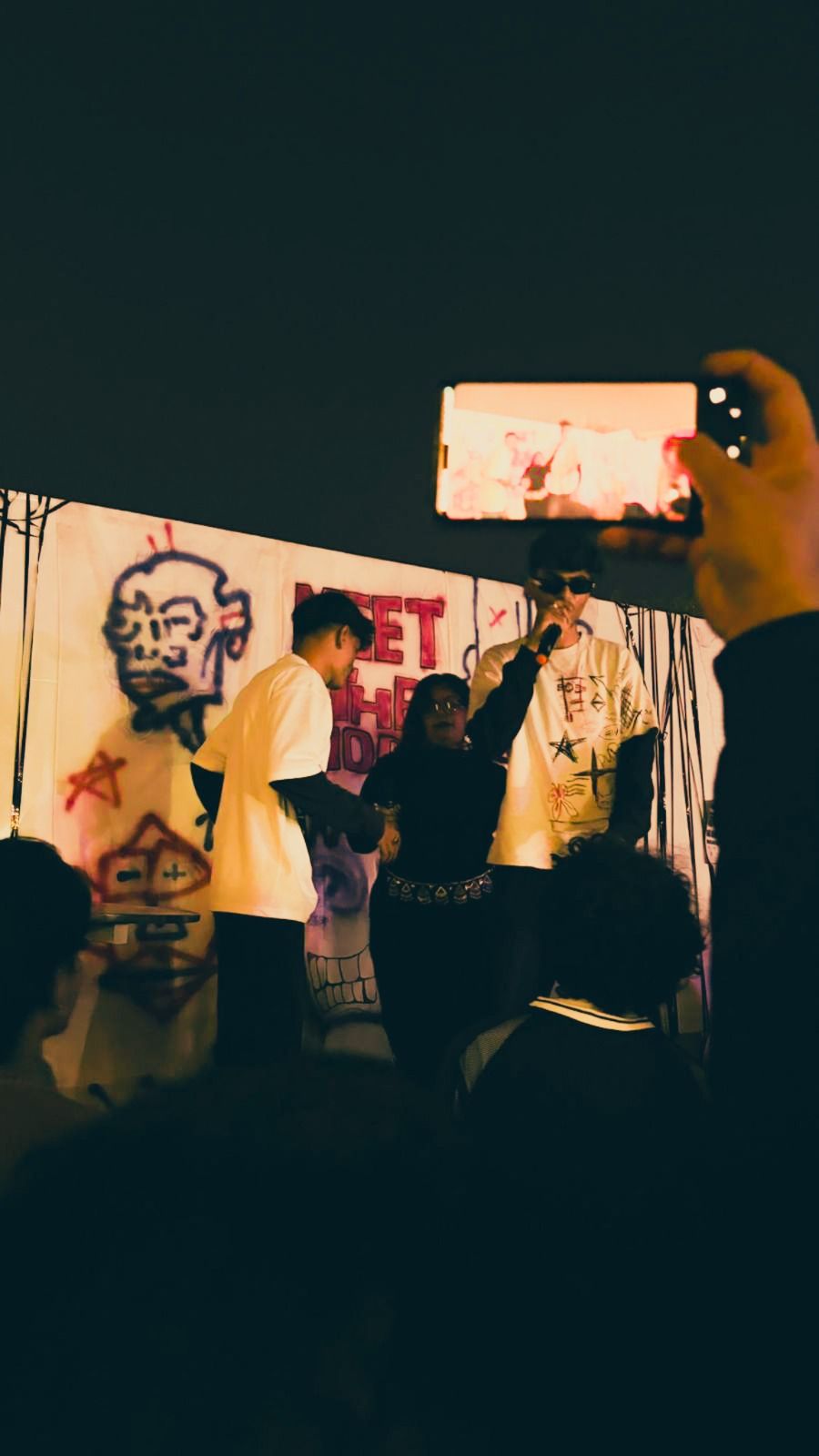
This was shot at Meet the Hood — a small, intimate live event, the kind where the stage is barely separated from the crowd.
What this photo captures is a moment of collapse between performer and audience. The artist is mid-performance, mic up, fully locked in — and right in front of him, a fan has crossed onto the stage, drawn in by the energy. That boundary dissolving is the story. It wasn't choreographed. It's what happens when an area is small enough and the music is loud enough that people forget where the performance ends and they begin.
What I didn't plan but kept in the frame deliberately is the hand in the top right corner — someone else recording the same moment on their phone. Two ways of holding onto the same thing, in the same frame. The graffiti backdrops behind the artists reinforce the whole aesthetic — this wasn't a polished production, it was a community putting something raw into a room and watching it catch.
The darkness swallowing the foreground crowd and the warm stage light pulling the performers forward did the compositional work for me. I just had to be in the right position when the moment broke open.
Walk us through the editing choices you made for your wildlife or street shot.
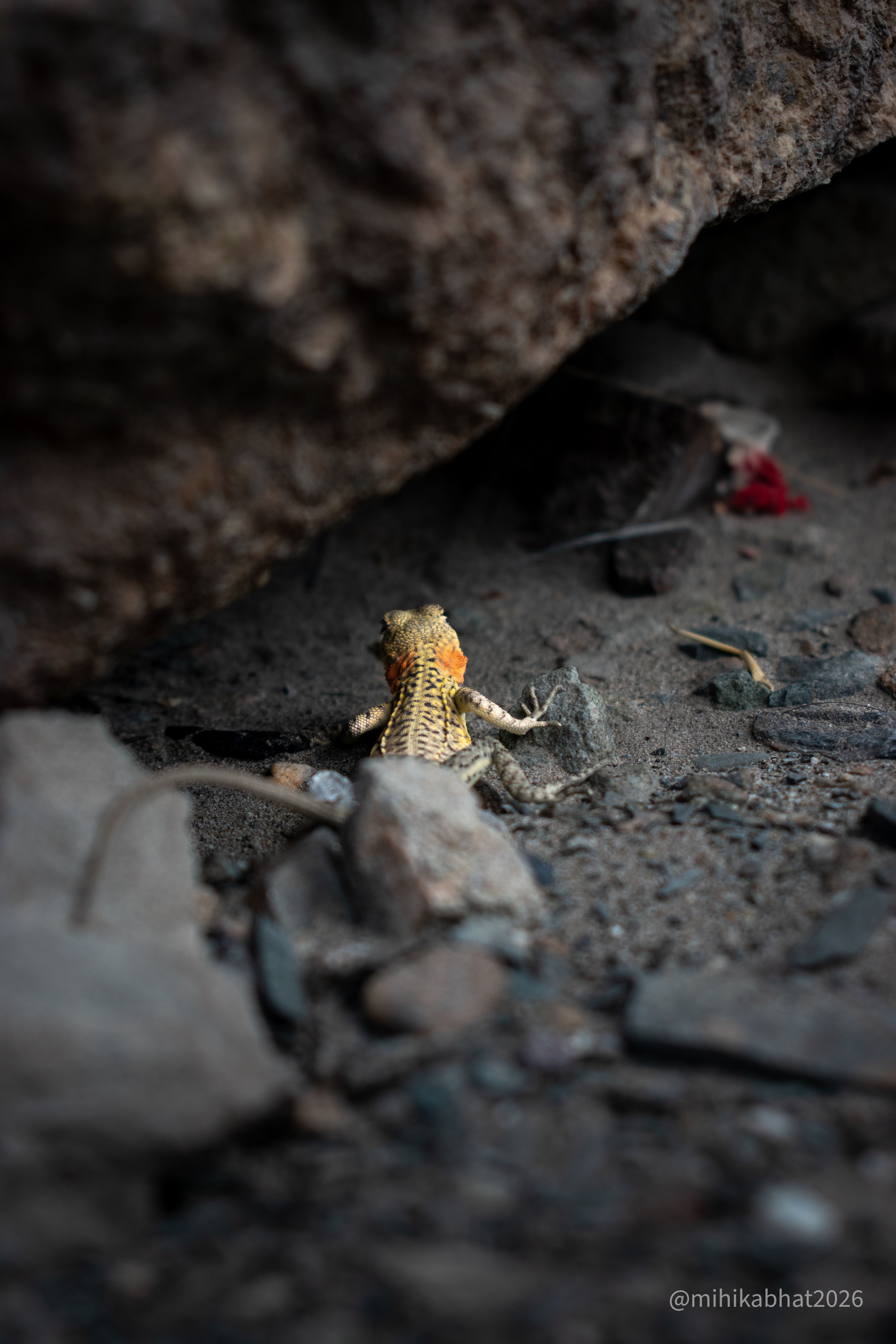
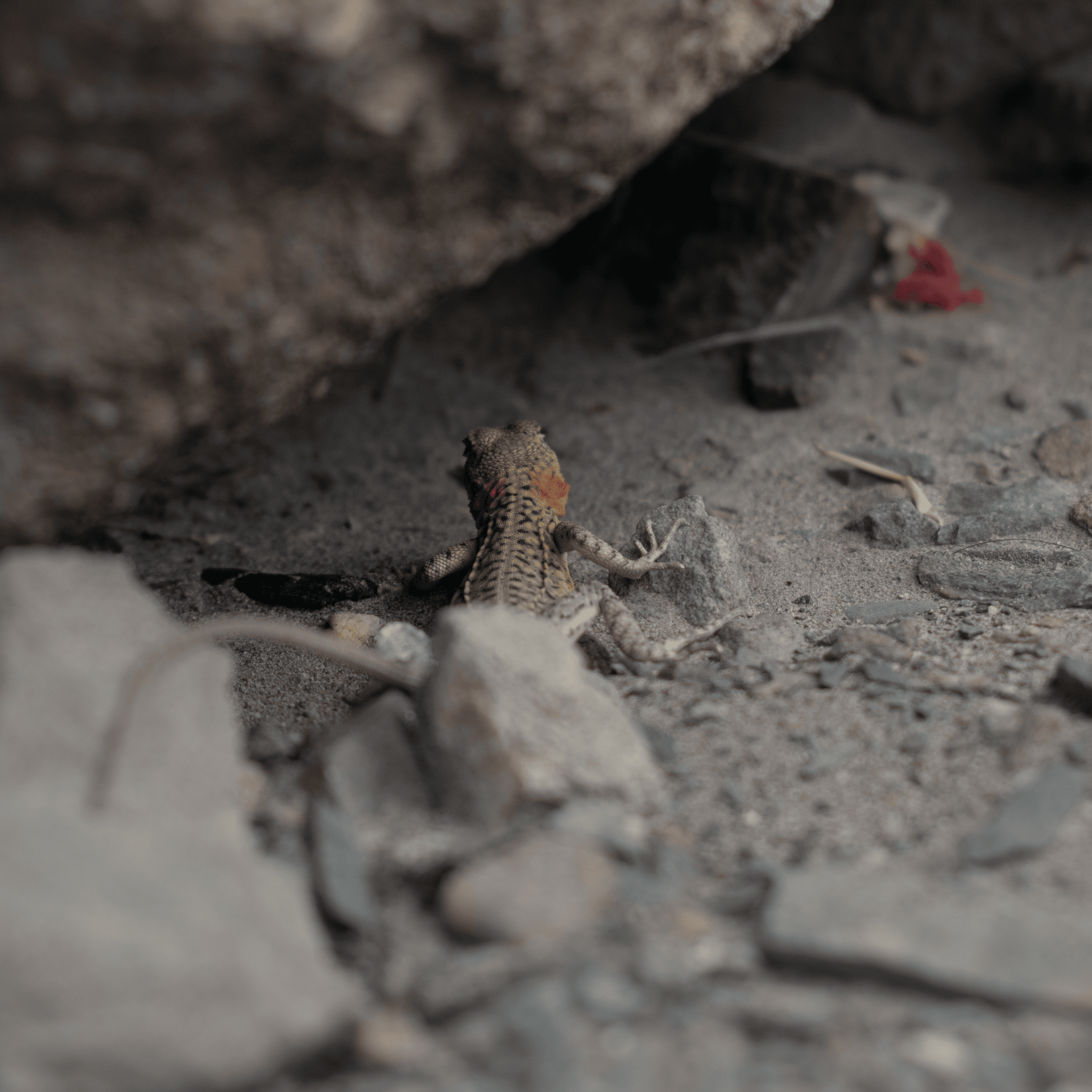
The original frame had a lot competing for attention — rocks, sand, debris, the shadow of the overhang above. The lizard was there but it wasn't commanding the frame the way it needed to. The edit was built around one goal: make the eye go to the lizard first and stay there.
I started by brightening the overall image to understand what I was working with, then pulled the background back — reduced exposure, pushed contrast, and used linear masking to progressively darken the edges. The idea was to close the frame inward, so the surrounding rock and sand recede rather than compete.
Then I worked on the lizard separately. I pushed the exposure, saturation and warmth on it specifically — and that temperature shift was the key decision. The orange-red on the lizard's head becomes the only warm element in an otherwise cold, grey frame. It functions like a signal flare. Your eye finds it immediately and the rest of the image falls into place around it.
The subject is mid-movement, heading toward the rock shelter above it. The edit reinforces that sense of urgency — a small, vivid thing moving through a vast indifferent landscape. Shot on a Nikon D3100, edited in Adobe Lightroom.
Contact and Follow
Instagram: https://instagram.com/the_portfolioproject
Behance: https://www.behance.net/mihikabhat
Email: mihikabhat0511@gmail.com